Conicia in your chat · free

Ask your AI anything. Except for reassurance.

Add Conicia to Claude or ChatGPT. When OCD asks the assistant for certainty again and again, it won't give it: it names the loop and offers one next step. When an urge hits, a short practice opens right in the chat. When you want to understand OCD, it teaches you. Free, two minutes to set up.

Claude, all plans ChatGPT Plus, Pro, Business
A real reply

1 · No reassurance

It won't give you the certainty. Here is what it does instead.

Reassurance feels kind for a minute and feeds OCD for a day. You know the loop: you ask, you feel better, you ask again. A chat assistant that answers every time is the most patient reassurance-giver ever built. Connect Conicia, and it changes what the assistant does with that question.

What it notices

The pattern, not the topic

Asking again something you already asked, here or anywhere. "Promise me." "Can you be sure?" Confessing something to see how it reacts. A what-if about who you are: "what if I'm secretly a bad person?" The same fear back in new words.

What it does instead

Acknowledge, name, one step

One sentence for the feeling. One sentence naming that this may be OCD asking for certainty. One next step, never a menu: a Right Now practice that opens in the chat, or putting the phone down and going outside. Then it holds, warmly, however many times you ask.

What it will not do

No certainty, not even sideways

No promises, no odds, no "you're probably fine", no debating whether the fear is realistic, no list of evidence either way. Softer versions count too: "not because it isn't true" is reassurance in a nicer coat.

Still a normal assistant

Ordinary questions get ordinary answers

"Am I developing diabetes?" asked once, plainly, gets an honest answer. The line is drawn at the pattern of certainty-seeking, not at scary topics. If a message suggests you are in danger, it is never treated as the pattern: you get 988 and 911, first and only.

Your choice

A boundary you set, like the ones in therapy

It works in the chats where Conicia is connected, and you can remove it at any time. That is by design: friction, not a wall. If you work with a clinician, show them this page and set it up together; what happens in the chat is worth bringing into the next session.

2 · In the moment

When an urge hits, help opens inside the chat.

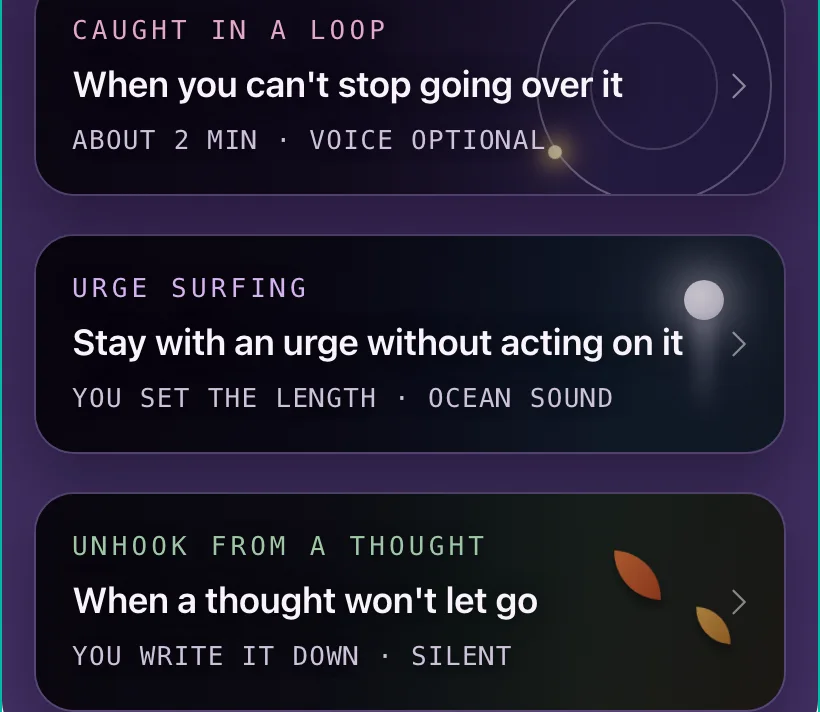
Say "open my Right Now tools" and a card opens in the conversation, no app to find, no tab to switch. Two to ten minutes. Nothing you do inside the card is saved or shared.

Caught in a loop

When you can't stop going over it

Five short guided beats that help you set the loop down, then a pivot back to what you were doing before it grabbed you. About two minutes, voice optional.

Urge surfing

Stay with an urge without acting on it

You set the length. Ocean sound, a sea to look at, and the urge rising and falling while you don't wash, check, or ask. It ends with a short closing screen.

Unhook from a thought

When a thought won't let go

You write the thought down and work one defusion technique, dealt at random. Silent. For a sticky thought you need some distance from.

3 · To understand

Two free lessons, taught in plain words.

From the Conicia course, built by a psychiatrist who has treated OCD since 2012: how OCD works, and what keeps it going. Ask the assistant to explain any part, at your pace, with your own examples in shorthand. The full course, and exposure work with a clinician, live in the Conicia program.

And one refusal

It will not run your exposure work

Exposure practice is the heart of treating OCD, and it belongs with a clinician, inside the program, where it is planned, timed and logged. Ask the assistant to build a ladder and it opens a door to the program instead of improvising one.

Privacy, in plain words

Conicia never sees your chat

The connector only learns which card was opened. It never receives what you type, and it stores nothing about you. The chat itself belongs to the assistant's company, under your settings there. Inside a card, nothing is recorded.

Set it up

Two minutes, and it stays.

Copy the link below, then follow the steps for your assistant. You do this once; from then on Conicia is there in every new chat.

2 · In Claude

Free, Pro and Max · web and app
  1. Open Customize, then Connectors.
  2. Tap +, then Add custom connector.
  3. Paste the link, name it Conicia, tap Add.
  4. Start a new chat and write Open my Right Now tools. When Claude asks for permission, choose Allow always.

The Free plan allows one custom connector; this can be it.

2 · In ChatGPT

Plus, Pro and Business · on the web
  1. Open Settings, then Apps (called Plugins or Connectors on some accounts).
  2. Open Advanced settings and switch on Developer mode.
  3. Tap Create. Name it Conicia. Connection: Server URL, paste the link. Authentication: No authentication. Tick the box, tap Create.
  4. Start a new chat and write Open my Right Now tools.

Leave "Advanced OAuth settings" alone: Conicia's free door has no login. A listing in the ChatGPT app directory, with no developer mode needed, is on its way.

Then try it. In a new chat, write Open my Right Now tools. A card should open in the conversation. If nothing happens in ChatGPT, tap + in the message box and switch Conicia on.

Not for emergencies

Conicia cannot help in an emergency, and neither can a chat assistant. If you are in danger of harming yourself, call or text 988 in the US, call 911, or go to the nearest emergency room. Outside the US: findahelpline.com. Inside every Conicia card, these numbers sit at the top.

Questions

Before you add it.

Is it free?

Yes. The free door costs nothing and needs no Conicia account. It has the two free lessons, the three Right Now practices, and the no-reassurance support. The full program, with the whole course and exposure work with your clinician, lives at my.conicia.com.

Why won't it just reassure me?

Because reassurance feels kind for a minute and feeds OCD for a day. Asking again, "just to be sure", is the compulsion. The assistant will still answer a real question once. When the same fear comes back in new words, it holds the line warmly and offers one next step: a practice, or simply putting the phone down.

Does Conicia see what I write?

No. The connector never receives your messages. It only learns which card was opened, so a practice can start. Nothing you do inside a card is saved, and nothing is shared with anyone. Your chat stays with the assistant's company, under the privacy settings you chose there.

Is this therapy?

No. It is education and self-help, designed by a psychiatrist who treats OCD. It does not diagnose, and it does not replace a clinician. Exposure work, the core of OCD treatment, is done in the Conicia program together with a licensed clinician, never in the chat.

Which assistants work today?

Claude on every plan, including Free, on the web and in the apps. ChatGPT on Plus, Pro and Business, on the web, with developer mode switched on. A listing in the ChatGPT app directory is in progress; once it is live, ChatGPT users will add Conicia with one tap.

I am in the program. Is this for me too?

Yes, and there is a fuller version for you: your whole course in the chat, with brainstorming for ladder steps that you then save in the app. Ask your clinician or write to us at support@conicia.com.

I am a clinician. How do I use this with clients?

Send them this page, or set it up together in session (two minutes). Agree on what it is: a boundary they chose, like the ones you set together for family reassurance. Ask about it in the next session: what did the assistant say, what did they do next. Clients in the full Conicia program get a fuller version, with their course in the chat and a door into their exposure work with you.

Does it work in every chat?

It works in the chats where Conicia is connected, on that account. A new chat elsewhere, or another assistant, has no line. The client can also remove it at any time. That is deliberate: it adds friction to the compulsion, it does not build a wall, and the clinical work stays with you.